
Misallocated effort
Why capable people still struggle to decide well at work

I remember the day our new bed was delivered. The mattress was like a small work of art. It was firm but not harsh, soft but not squishy. Then came the issue of the legs. We were offered two choices, same price, same quality, but different looks.
I must have stood there for a full minute weighing the options.
And then I stopped. Because I suddenly realized: this doesn’t matter.
Nothing about which leg color we picked would impact how I sleep, how I wake, or how I show up the next day. And yet it had sucked me into a tiny vortex of indecision. It felt like one of those moments where the mind whispers: if this feels hard, it must be important. But that’s a trick our minds play on us, and it’s costing us precious attention and mental resources.
It turns out this is surprisingly common.
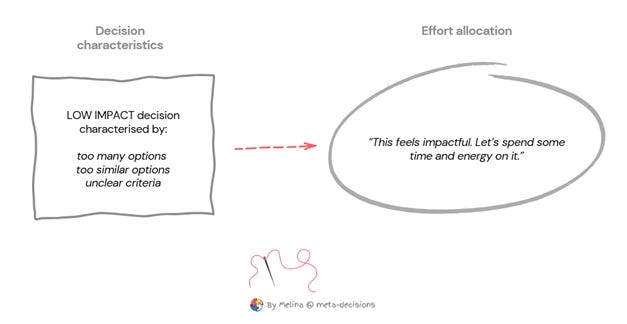
When felt difficulty becomes a misleading signal
We often treat the felt difficulty of a decision as a proxy for its importance. When a small decision feels difficult, we unconsciously conclude it must be important, so we must be careful. We slow down, revisit options, and feel uneasy about moving on. It becomes something we want to get right, to be seen engaging with, and to avoid mishandling in front of others.
This is known as decision quicksand in my field: when we spend more time and energy on trivial decisions than on the ones that really make a difference. This can happen for example when we are faced with multiple options, trade-offs are subtle, or criteria are fuzzy. Even small decisions can start to feel heavy. Not because the consequences are large, but because the act of choosing demands effort.
What’s subtle, and what’s frustrating, is that nothing about these decisions feels trivial in the moment. That’s why we can spend more time choosing shoes than choosing a laptop, picking the color of our walls than picking where to spend our time this quarter.
In the workplace, this means that we spend a lot of time debating the choices that have little impact, while the choices that have real impact are made under pressure or treated as operational details. This is how teams spend time debating the wording, the formatting, or the process details, while decisions about direction, ownership, or risk are made with little pause.
This isn’t typically a deliberate mistake. It’s a result of how our judgement reacts to complexity, uncertainty, and the cues around us. What gets lost is the distinction between a choice that is difficult to make and a choice that impacts something important.
Difficulty can come from too many similar options, competing preferences, or unclear criteria about what good looks like. It can also come from the pressure to appear thorough or aligned. Impact has to do with consequences. What actually changes if the decision goes one way rather than another. Who is affected. For how long. And how hard it would be to reverse. When those two are confused, energy gets misallocated. Teams slow down where they could move quickly, and move quickly where reflection would help.
In a world where we’re constantly choosing, attention becomes the real limiting resource. Every mental hour has a cost, and every little decision chips away at our reservoir. This is decision fatigue in action: the declining quality of decisions as our cognitive resources drain. When we let small choices soak up disproportionate energy, we arrive at the big decisions tired, distracted, and more likely to default to familiarity or avoidance.
The pattern: the behavioral aspect of effort allocation
You see this play out between people, not just within minds.
In many organizations, effort is visible. Long conversations signal care. Detailed analysis indicates competence. Acting quickly can appear careless, even when it’s called for. At the same time, some decisions carry social risk. Questioning them can feel disruptive. Slowing them down can feel political. These are often the decisions that shape direction, ownership, or accountability.
So energy flows toward what feels safe to talk about, not necessarily what’s most important. Anyone who has spent time in high pressure meetings will recognise this pattern. People manage impressions. They follow cues about what is rewarded. Over time, those cues quietly teach people where to invest attention.
Even capable, well-intentioned people struggle with this when the context works against them. If meetings reward thoroughness over clarity, energy leaks. If escalation is easier than prioritisation, everything becomes important. If uncertainty is uncomfortable, people gravitate toward decisions that feel manageable rather than consequential. Judgement does not operate in isolation. It is shaped by what the environment signals as legitimate.
The reframe
When we talk about decision quality, we usually mean choosing well among options. Less often do we mean choosing where to invest attention. Yet that choice often determines everything else. Not every decision deserves careful deliberation. Some require haste. Some require defaulting. Some require delegation. And some require vastly more attention than they currently receive.
The problem is that our minds provide us with very poor signals about which is which. Feeling stuck is not a good signal.
The tool I developed to get out of decision quicksand and stop leaking energy involves a sorting mechanism called decision quadrants. Its frame comes from risk management: the impact–frequency matrix.
You plot a decision along two axes: impact (how significant are the consequences?) and frequency (how often do I face this type of decision?). When you do that, four distinct quadrants appear.
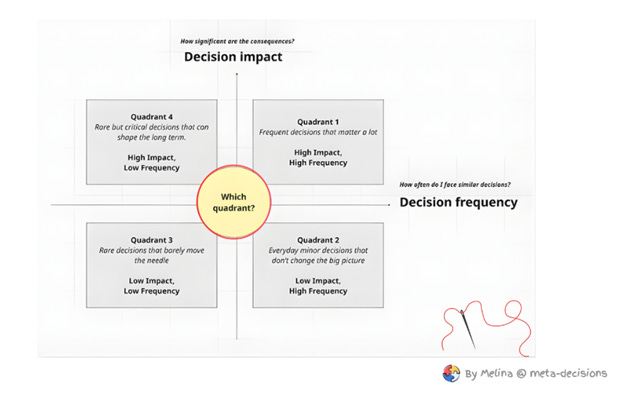
Quadrant 1 is where high impact, high frequency decisions reside. These are the decisions that shape your trajectory repeatedly. Hiring standards, investment criteria, how you prioritize your week. These deserve systems. They deserve reflection and a thorough process to get them right. Get these wrong, and the cost compounds. Quadrant 2 is the place for low impact, high frequency decisions or the daily micro-choices. What to wear. What to order. Which email to answer first. Individually trivial but cognitively draining if overanalyzed. These choices are good candidates for defaults and automation. Decisions in Quadrant 3 are both low impact and low frequency. They are rare and inconsequential. They might feel heavy in the moment because they’re novel, you are not used to dealing with them. But they barely move the needle. The bed legs live here. And, finally, Quadrant 4 is where we find the high impact, low frequency decisions. Infrequent but pivotal. Career moves, strategic partnerships, major investments. Decisions that require deliberate attention because they alter the long term.
When you consciously sort decisions into the right quadrant, you avoid overthinking the small stuff and underthinking the big ones. It’s a way to help you decide how to decide.
The next time you find yourself making a decision that feels heavy, ask yourself whether the heaviness is coming from what’s at stake, or from felt difficulty. In which Quadrant does your decision problem really lie?
I will follow up on the Decision Quadrants tool. If you missed it or want more information at the time you are reading this article, DM or reach out at melina@meta-decisions.com
I write about how judgement, interaction, and context shape decisions at work, and how small behavioural shifts can make a meaningful difference over time.